

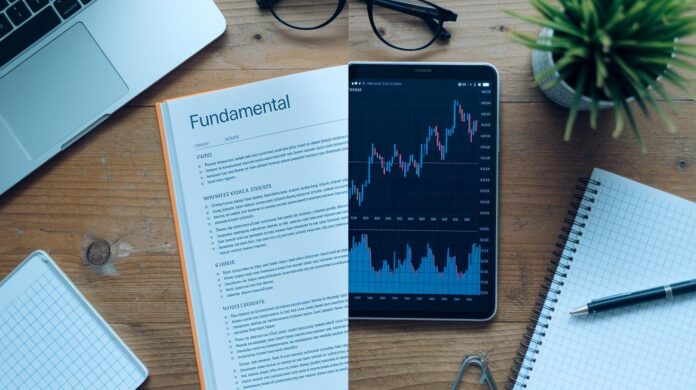
Ever wonder if smart investing is all about checking a company’s true worth or watching its price shifts like a heartbeat? Let’s chat about it. On one side, we have fundamental analysis, where you dig into a company’s report card, its earnings, debts, and growth, to get a clear picture of its value. On the other, technical analysis watches price changes, following them like the gentle ripples in a pond.
So, which method speaks to you? Maybe you like the idea of a deep dive into financial details, or perhaps you prefer keeping up with the swift pulse of market trends. Stick with us as we explore how these approaches can guide your investment decisions, helping you build a strategy that feels just right.
How Fundamental Analysis vs Technical Analysis Differ at a Glance

Fundamental analysis is all about digging into a company’s true worth. You look at things like financial statements, quarterly earnings, and profit margins to understand how healthy the company really is. Think of it like checking a school report card, it shows whether the business has strong potential for long-term growth. For example, an investor might check a company's debt-to-equity ratio (a measure of financial stability) to see if it’s on solid ground.
Technical analysis, however, takes a different approach by focusing on historical price movements and market trends. It relies on chart tools such as moving averages, trendlines, the Relative Strength Index (RSI), and volume analysis to spot trading opportunities. Imagine a trader noticing a moving average crossover, like watching ripples in a pond that hint at a change coming in. This method feels a bit like detective work on market charts.
In essence, while fundamental analysis gives you a big-picture view by digging deep into financial details, technical analysis zooms in on short-term price swings and market mood. Investors who are in it for the long haul might lean toward fundamental methods, whereas those chasing quick gains often trust technical signals. A day trader, for instance, might watch RSI and volume metrics closely to decide when to buy or sell, balancing risks and rewards with every move.
Fundamental Analysis: Core Principles and Valuation Metrics

Fundamental analysis is basically like giving a company a financial check-up. You look at its earnings, its balance sheet strength, and the overall industry vibe, just like checking a house’s foundation before buying it. This helps you see if a stock is undervalued or if it really has solid long-term potential.
There are a few key tools we use for this analysis:
- Price-to-Earnings (P/E) Ratio
- Price-to-Book (P/B) Ratio
- Return on Equity (ROE)
- Debt-to-Equity Ratio
- Dividend Yield
These measures reveal how a company is really doing. For instance, if you find a company with a low P/E ratio and a high ROE, it might be a hidden gem that the market has overlooked. This kind of insight helps investors pick stocks with strong growth prospects while keeping an eye on risk.
Think of it like reading a thermometer to decide if it’s time to take action. These metrics provide clear signals so each investment decision is both careful and smart.
Technical Analysis: Key Techniques and Chart-Based Methods

Traders use different charts to spot trends and decide when to buy or sell. They often use candlestick, bar, or line charts to show how prices change over time. Trendlines on these charts help mark important support and resistance points by connecting highs and lows, so emerging patterns become easier to spot. This method taps into historical data, giving traders a clearer picture of past performance.
Moving averages help smooth out price data, showing the market’s overall direction by filtering out the day-to-day ups and downs. The Relative Strength Index (RSI) tells you when an asset might be overbought or oversold, which can be a sign of a coming change. Plus, volume analysis, keeping an eye on how many shares or contracts are traded, adds another layer of insight. If you see high trading volumes during a price move, it usually confirms that the trend is strong. Together, these tools help traders balance risk while catching short-term opportunities.
If you’re interested, try these techniques with a day trading simulator (https://cipherstonk.com?p=90) before diving in with real money. It’s a smart way to see how these chart-based methods work in real time and to build your confidence in your strategy.
Fundamental Analysis vs Technical Analysis: Pros and Cons

| Approach | Advantages | Disadvantages |
|---|---|---|
| Fundamental Analysis | Gives you a full picture of a company’s financial health by looking at earnings, revenue, and other key numbers. | Takes a lot of research and might not catch quick market moves, so it’s not always great for short-term changes. |
| Technical Analysis | Makes it easier to act fast by focusing on market mood, chart patterns, and simple tools like moving averages and RSI (a tool that shows if a stock might be overbought or oversold). | Sometimes it can give false signals, especially when trading volume is low or during strange market days, which might lead to wrong calls. |
When it comes to choosing a method, think about your own risk comfort and trading style. If you’re planning to invest for the long haul and like digging into a company’s numbers, you might lean toward fundamental analysis to build a steady portfolio. On the flip side, if you enjoy keeping an eye on the market’s pulse and reacting quickly, technical analysis might be your best bet for catching short-term chances.
It all comes down to how much time you can spend watching market changes. If you can’t check in every day, leaning on fundamental insights can help set up a solid portfolio over time. But if you’re more into frequent market reviews, technical analysis might be a better fit, helping you manage risk while timing your moves just right.
Timing and Use Cases for Fundamental vs Technical Analysis

For long-term investors, the game has changed. Today’s fundamentals go beyond old-school metrics, offering interactive case studies and fresh data sets. Picture an interactive dashboard that shows sustainability scores, ESG benchmarks, and live company trends. You might see a case where a firm’s move toward green energy has boosted its dividend stability, all laid out in a dynamic chart that tracks increasing yields and improved ESG ratings.
Meanwhile, traders looking at medium and short timeframes are embracing digital platforms that mix historical charts with real-time feeds and even hints from social sentiment. These platforms use smart indicators, like algorithm-driven volume spikes paired with social insights, to help catch those market shifts minute by minute. Imagine a tool that spots a sudden change on a live chart and prompts a trade capturing a quick 3% gain.
In short, using a blended strategy seems the smartest move. Dividend investors can follow detailed company highlights and sustainability markers on interactive fundamental platforms. At the same time, swing traders can ride real-time technical signals and algorithmic insights to time their entries and exits perfectly. This approach keeps a long-term vision alive while seizing immediate market opportunities.
Integrating Fundamental Analysis and Technical Analysis for Better Signals

Investors mix fundamental and technical analysis to make smarter choices. They start by screening stocks using simple criteria like profit margins, revenue growth, and other financial numbers that show a company’s long-term promise. Then they use technical signals, like a moving average crossover or an RSI (a tool that measures if a stock is overbought or oversold), to decide when to buy or sell. In short, this combo lets you use both deep financial insights and fast market signals to aim for steady growth while handling short-term ups and downs. It’s a balanced method that helps both careful investors and quick traders.
Fundamental Screening
In fundamental screening, investors set basic rules using financial ratios and revenue targets to pick stocks. For example, a trader might look for companies with a low P/E ratio to find undervalued opportunities. This step cuts down the list to stocks that show strong long-term potential, laying the groundwork for solid investment decisions.
Technical Trigger
Next up is the technical trigger phase, where investors examine stock charts for clear signals to time their trades. A moving average crossover or a jump in momentum indicators like RSI can point to the right moment to enter or exit a position. These signals back up what was found during the fundamental check, making the trading process sharper and more precise. They also give traders the confidence to act when the market seems right.
When signals conflict, investors keep risk management in focus. They might shrink their positions or wait until the signals line up more clearly. This careful approach helps protect their capital during uncertain times.
Real-World Examples: Applying Fundamental vs Technical Analysis

Take Costco's performance as a simple example. Its net sales jumped by 6.9% to reach $186.07 billion in just 39 weeks. Add to that a $4 billion stock buyback, a 30% rise in stock value since the start of the year, and a steady dividend yield. These numbers let investors see the company's strong base and long-term promise, kind of like reading a clear financial report that shows steady, reliable growth.
Now, imagine a trader keeping an eye on the charts for extra confirmation. Picture a chart where Costco’s price climbs above a long-term moving average and the RSI (a tool that gauges if a stock is too hot or too cold) hits over 70. These signs hint that the stock might be about to rally, prompting the trader to act quickly. This chart-based approach lets traders jump in based on what they see happening right before their eyes.
Mixing these two methods really sharpens decision-making. When investors blend strong company fundamentals with timely trading signals, they can manage risks better while grabbing the right opportunities.
Final Words
In the action of comparing fundamental analysis vs technical analysis, we broke down key methods that shape smart investing. We explored how assessing a company’s financial health pairs with studying market patterns to signal the right time to act.
The post outlined both long-term value perspectives and short bursts of market timing, offering clear tips for matching strategies to risk tolerance and style.
Embracing both methods can boost your confidence and help optimize your portfolio, stepping forward with clarity and positivity.
FAQ
What are the main differences between fundamental and technical analysis?
The main differences between these methods are that fundamental analysis looks at a company’s earnings, revenue, and economic factors, while technical analysis focuses on price patterns and trading signals to predict market moves.
Which method is better, fundamental analysis or technical analysis?
The method that is better depends on your goals; fundamental analysis helps determine long-term value based on financial data, whereas technical analysis suits short-term trading with chart patterns.
Should I learn fundamental or technical analysis first?
Learning fundamental analysis first gives you a solid understanding of a company’s financial health, while technical analysis can then help you fine-tune timing for entries and exits in the market.
What is an example of fundamental analysis?
An example of fundamental analysis is reviewing a company’s financial statements, such as its earnings report and balance sheet, along with economic indicators to assess its intrinsic value.
What does FA versus TA mean?
FA versus TA means comparing how fundamental analysis evaluates company performance and intrinsic value, while technical analysis uses historical price data and trends to guide trading decisions.
Where can I find resources like PDFs, PPTs, charts, or Reddit discussions on fundamental versus technical analysis?
You can find a range of resources on the subject—PDFs, presentations, charts, and even active Reddit discussions—that provide different perspectives and detailed comparisons between these two analytical methods.
How do quantitative and sentiment analysis compare to fundamental or technical analysis?
Quantitative analysis uses mathematical models and algorithms, and sentiment analysis measures market mood, which offer additional layers of insight compared to the company-focused fundamental analysis and the pattern-based technical analysis.