


Few investors have distilled the art of buying businesses at the right price better than Joel Greenblatt. In one legendary lecture, the author of “The Little Book That Beats the Market” laid out a roadmap for rational stock picking that still feels fresh today. Instead of chasing fads or obsessing over textbook “value” ratios, Greenblatt argues for rigorous, common-sense valuation work and an owner’s mindset. His six big ideas—ranging from why most investors fish in the wrong pond to how free-cash-flow yield can anchor your analysis—remain essential reading for anyone who wants to beat the market without losing sleep. Below, we unpack each insight and point you to even more resources.
Not "Value" but "Valuation"

Conventional screens for low price-to-book or price-to-sales ratios often masquerade as value investing, yet they ignore the real question: what is the business actually worth? Greenblatt reminds us that multiples are only shorthand. The serious work is estimating future cash flows, discounting them sensibly, and comparing that figure to the current quote. Momentum may dominate a cycle, but price ultimately converges on value. Treat each company like a private purchase, would you buy the whole thing at today’s market cap? If the gap between intrinsic worth and sticker price is wide enough, you have valuation investing, not just a cheap-looking statistic.
Is Outperformance Still Possible?

With armies of MBAs, quants, and AI models crawling over every tick, it’s easy to believe active management is dead. Greenblatt’s counterpoint is the market’s own history: the S&P 500 doubled, halved, doubled, halved, and then sextupled between 1997 and today. Those wild swings reveal one thing, people remain emotional. Panics and manias create mis-pricings that disciplined investors can exploit. You don’t need to beat every professional; you just need the courage to buy when the crowd is fearful and sell when it’s euphoric. Volatility is not the enemy; it’s the raw material of superior returns.
Differentiate for Superior Performance

If everyone fishes in the same pond, say, the S&P 500, catches will look alike. Greenblatt argues that outperformance requires venturing beyond the obvious. Small and mid-caps, spin-offs, and misunderstood niche players often trade at steeper discounts precisely because they are ignored or deemed “too hard.” The further you stray from the glamour names, the wider the performance dispersion becomes, both positive and negative. Diligence matters: verify the numbers, interview management, and demand a margin of safety. When you finally pull the trigger, you’re buying a business most investors haven’t bothered to study, giving you a true informational edge.
Valuation Metrics That Matter

Greenblatt’s favorite starting point is free-cash-flow yield: free cash flow per share divided by price per share. A double-digit FCF yield often signals an “absolutely cheap” company, but he doesn’t stop there. Next comes “relative cheap”, comparing that yield and other key metrics to direct competitors. A firm that is both absolutely and relatively cheap offers the best odds of a favorable outcome. Layer in balance-sheet health, reinvestment opportunities, and capital-allocation skill, and you have a robust framework that transcends simplistic P/E shortcuts.
Valuation Is Like Gravity

Overpaying is hazardous because gravity, valuation, eventually drags high flyers back to earth. Fewer than 1 percent of richly priced stocks will grow fast enough to bail you out. Yet investors line up for those lottery tickets, hoping to shout “I told you so!” when a Tesla or Amazon defies the odds. Greenblatt’s advice: skip the heroics. Plenty of unglamorous businesses churn out predictable cash at bargain prices. When your appraisal is sound, time becomes your ally; the market price will close the gap sooner or later. Let others chase outliers while you compound steadily.
The Fallacy of Diversification

Wall Street’s 30-stock rule of thumb stems from portfolio theory, not owner logic. If a neighbor owned six thriving hometown businesses, no one would call him reckless. Why should a public-equity investor be different? Greenblatt believes deep knowledge of a handful of companies beats shallow familiarity with dozens. Concentration forces you to understand the drivers, monitor risks, and think like a proprietor. True diversification comes from knowing your positions cold and insisting on fat margins of safety, not sprinkling capital over every industry out of fear.
Grab the Columbia Class Notes
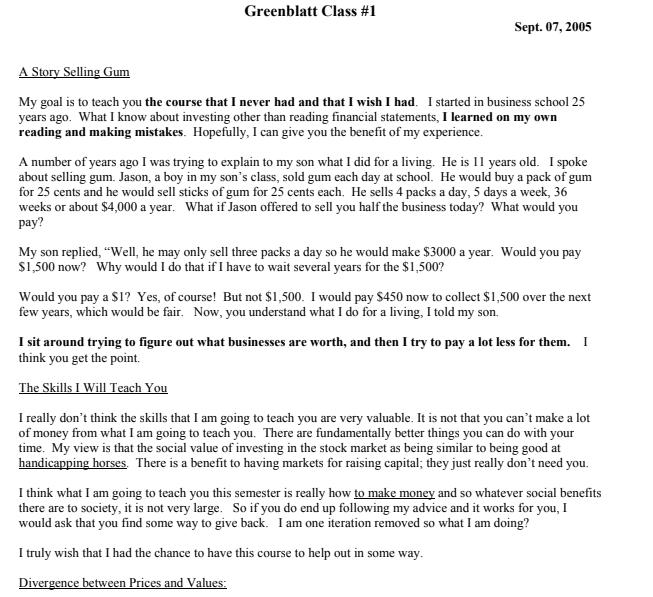
Want to dive deeper? Greenblatt’s Columbia Business School lecture notes, often shared among value-investing circles, expand on the principles above with real-world case studies, screening tricks, and Q&A sessions. The 100-plus-page PDF, available free online, walks you through calculating owner earnings, spotting accounting red flags, and structuring a focused portfolio. It’s a mini-MBA in rational stock picking. Download it, annotate it, and revisit it whenever the market’s noise grows deafening. Think of it as your field guide to staying disciplined when prices swing and headlines scream.